

Welcome
Welcome to Edition #011 of Strategy Made Simple.
This newsletter captures the best of what I’ve written, recorded and read since the last issue came out.
Enjoy.
Articles
I’ve published a new article titled, ‘Advertising’s Master Model’.
Here’s a quick TLDR:
In 2013, Les Binet and Peter Field published ‘The Long and Short of it’. The study found that two different types of advertising exist. ‘Brand building’ campaigns deliver long term improvements to a brand’s baseline sales. They generate demand by reaching all consumers with emotional messages. ‘Sales activation’, on the other hand, deliver short term sales spikes. They exploit demand by targeting existing consumers with rational messages. But this theory should not be thought about in isolation. This article argues that Binet and Field’s framework overlaps with five other theories, drawn from advertising, marketing, psychology and neuroscience. By bringing these six impactful ideas together, we can create a more complete, more cohesive, understanding of how brand communications work. I call this the 'master model'.
Thank you to everyone who has read, liked and commented on the article already.
Past articles
For the newcomers, here are a few of my recent pieces:
Marketing’s Misleading Metric: This article argues that ‘return on investment’ (ROI) is a malevolent metric that sits at the heart of many marketing discussions and decisions. I believe that the many marketers who prioritise this metric seek to capture value, but unintentionally destroy it. And there is three reasons for this. To maximise ROI marketers must prioritise efficiency over effectiveness. They must reduce their media money. And they must focus on the few consumers who are already most likely to convert. The result is an approach to advertising which suppresses a campaign’s profit producing potential. I realise this may sound unbelievable. Paradoxical, perhaps. So let’s work through these points one at a time.
Thinking Rationally About Emotion: In advertising, using emotion is entirely logical. Creative agencies have made this case consistently. But in 2013 a paper from the IPA bought some much-needed data to the discussion. The study found that emotional campaigns outperformed rational campaigns on every brand and business metrics that had been measured. But why is this? This article aims to answer this seeming simple question. It argues that emotional, brand-building communications are more effective because they attract more attention, create stronger memories and are more likely to be shared.
The Age of Average (encore): This article argues that the shift to music streaming has led to songs getting shorter, music getting less melodically diverse and lyrics getting more repetitive. Or to put it another way, just as our visual culture has become more homogeneous, so too has the music that accompanies it. Let’s run through these arguments one by one.
There are now a total of sixteen articles available, for free on my site.
Summaries

Since publishing the last edition of the newsletter I’ve summarised five marketing and advertising industry books:
In total, you can now find 34 book summaries on my website, each of them no more than a two minute read.
Keep an eye on my LinkedIn for the next summary.
Links
Here’s five of the best things I’ve read over the last few months.
The Extraordinary Cost of Dull
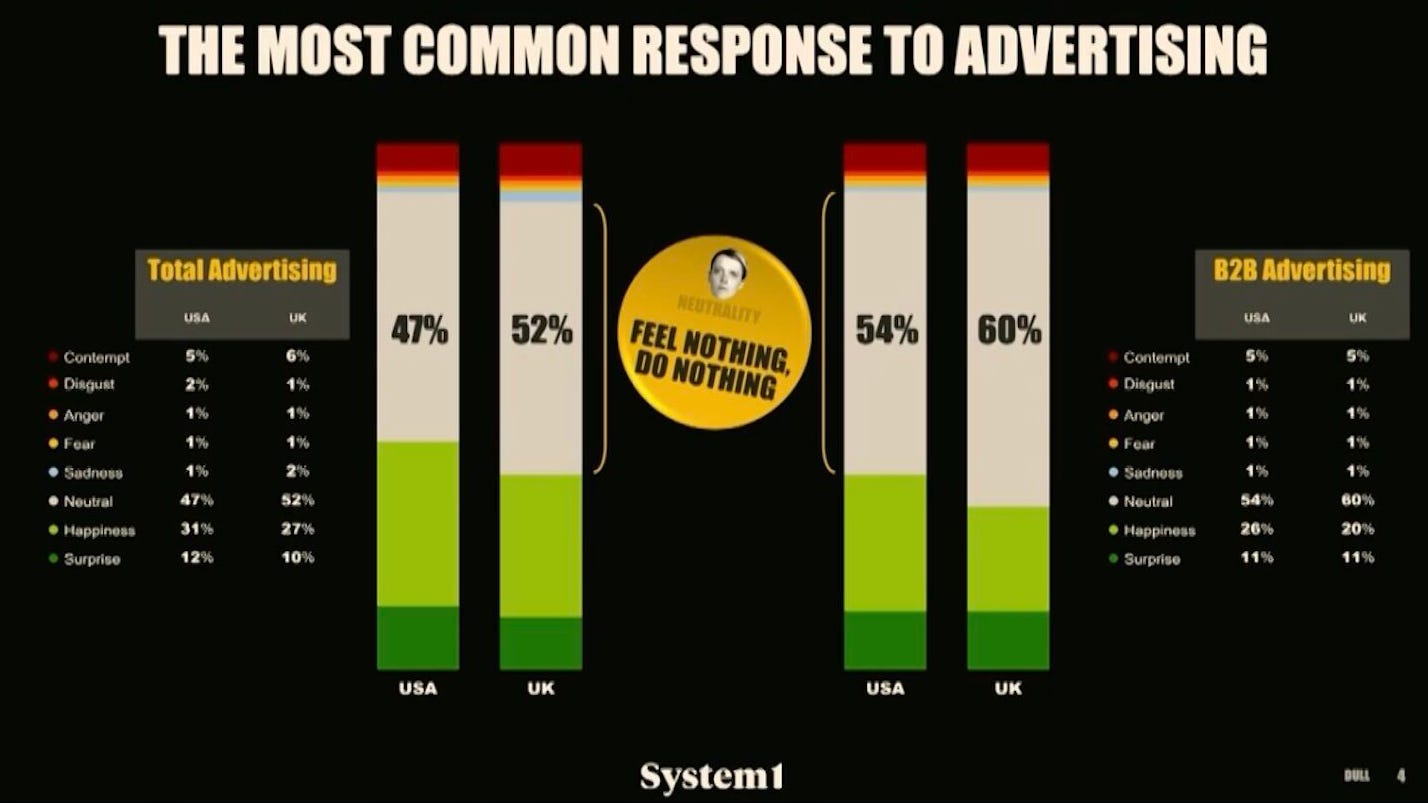
System 1 teamed up with Peter Field, the IPA and Adam Morgan to calculate The Extraordinary Cost of Dull in advertising. One of the key slides describes the percentage of ads that evoke each of eight emotions. Staggeringly 47% of US ads and 52% of UK ads trigger nothing but neutrality. No positive emotion, no negative emotion, just neutrality. And in B2B, the figures are even higher.
How brands grow… or not
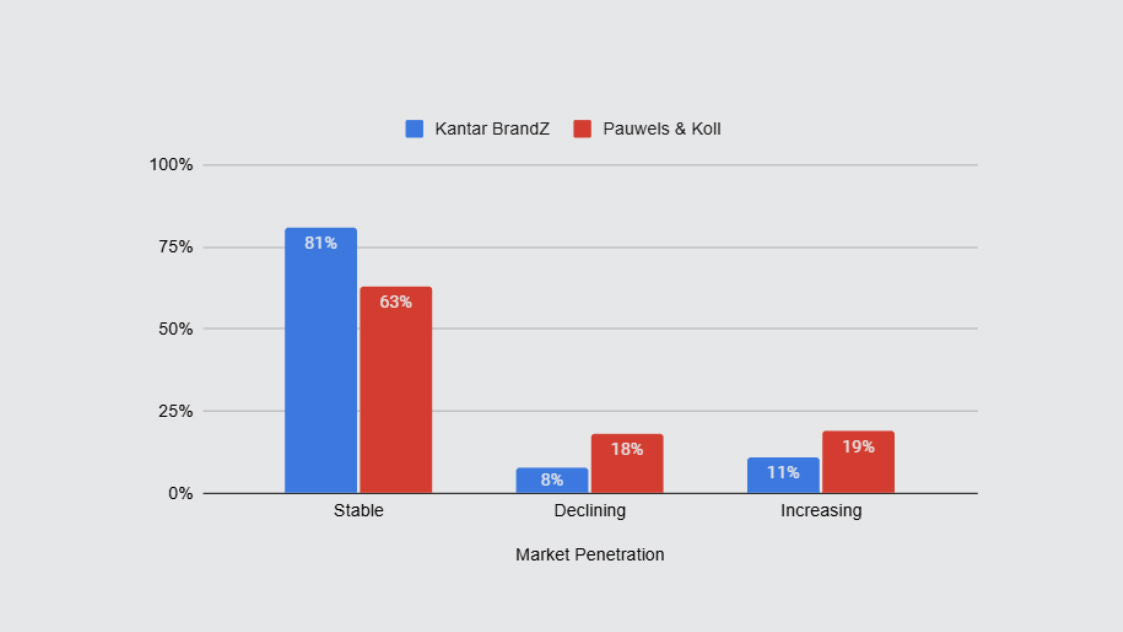
John James shared a chart that brings together two studies that quantified the percentage of brands that were stable, declining and growing. Whilst the studies’ specific figures are different, the story is the same. Looking at averages, 72% of brands are stable, 13% are declining and 15% are growing. What’s interesting is that, whilst growth is quite rightly celebrated within our industry, the vast majority of big brands have to work really hard to simply maintain their market position.
Half of brands rate their ability to develop insights as poor or very poor
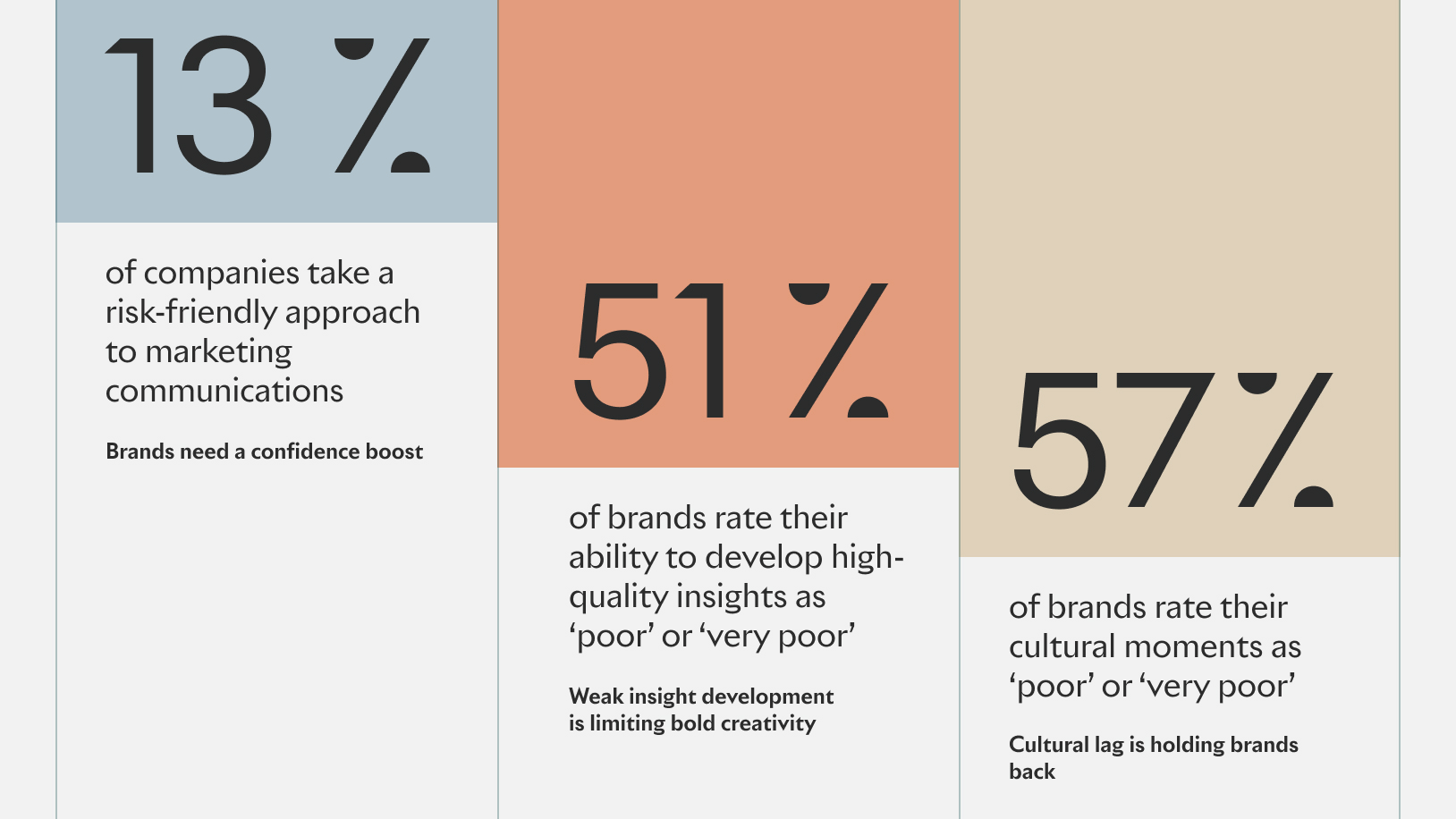
The fifth annual State of Creativity Study by Cannes Lions, surveyed over 1000 marketers and creatives globally. One of the most striking findings was that 51% of brands rated their ability to develop high quality insights as either ‘poor’ or ‘very poor’. Staggering.
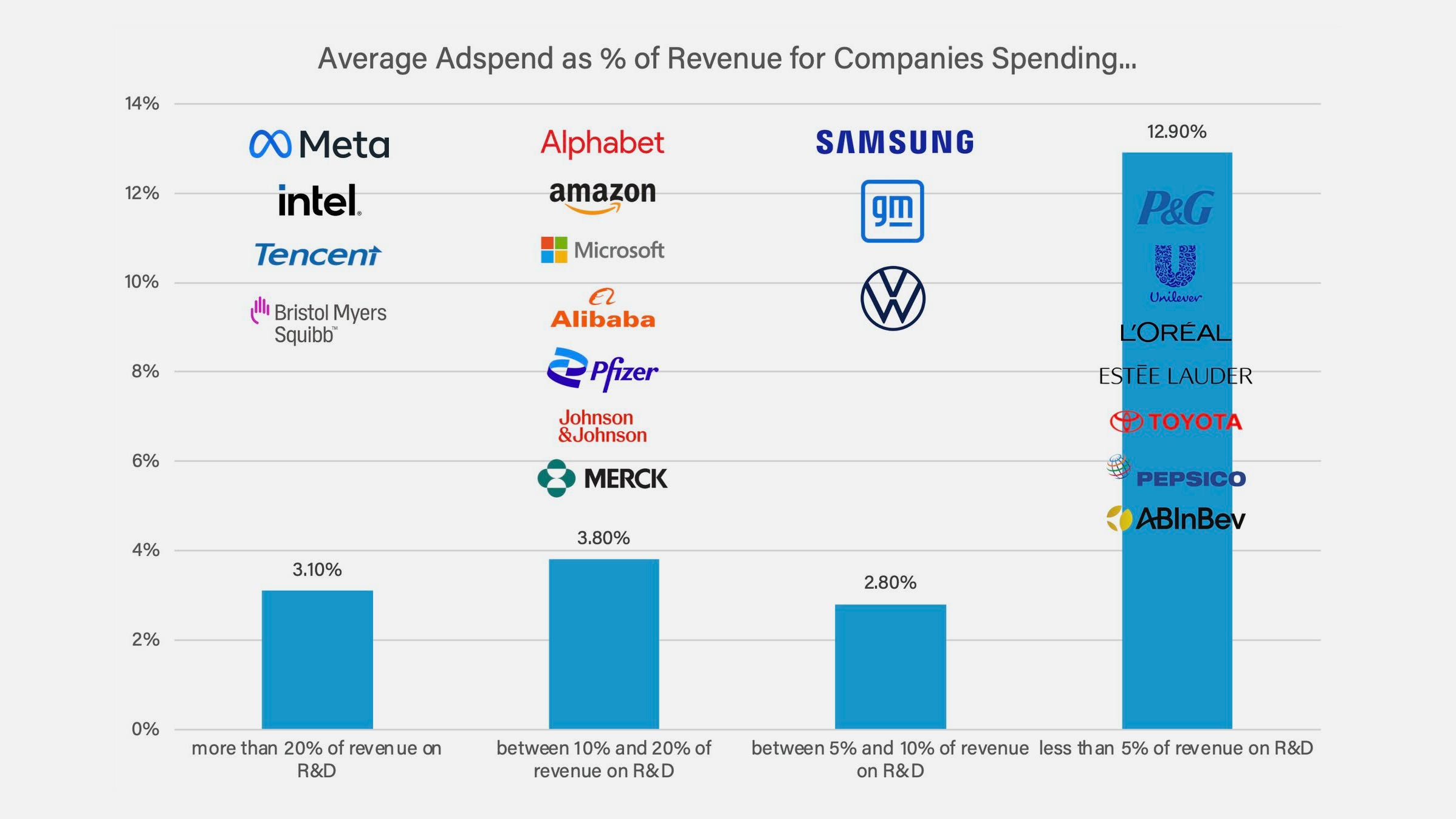
Companies are either advertising or innovation led
This chart shared by James Hurman is a little hard to decode, but I think it makes an interesting and rarely made point. I’ll do my best to simply explain it. The first three columns represent companies who invest over 5% of their revenues back into R&D. Roughly speaking, these companies also spend around 3-4% of their revenues on advertising. The fourth column represents companies that spend under 5% of revenue on R&D. And, unlike all the other columns, these companies spend around 13% of revenue on ads. That’s 3-4x more. The lesson is clear. Companies are either advertising led or innovation led.
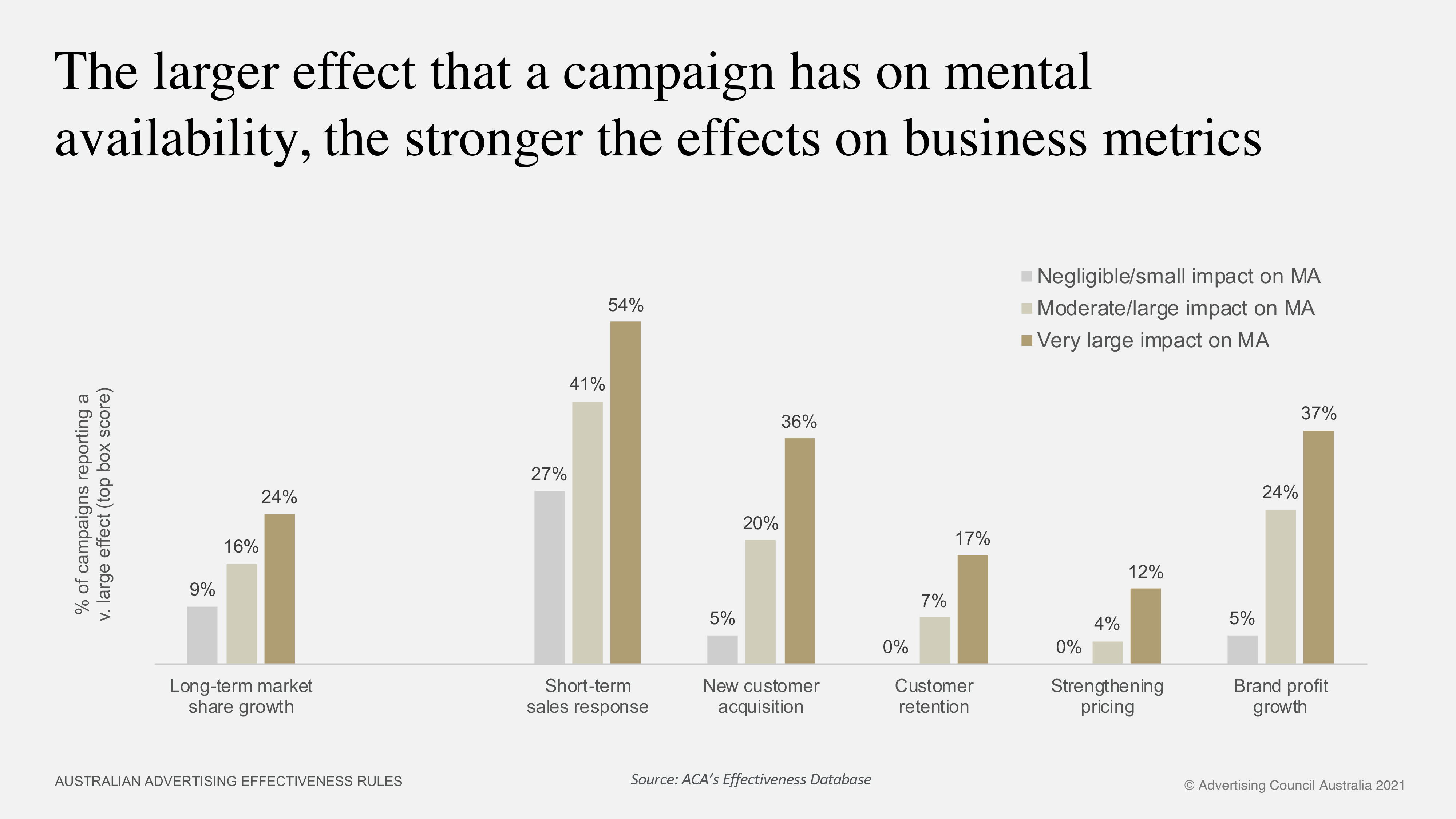
Stronger mental availability, means stronger business metrics
Over the last 15 years or so, the Ehrenberg-Bass Institute has developed the concept of ‘mental availability’ (MA). This is defined as the likelihood that a buyer will think of a specific brand in a buying situation. This is measured using consumer surveys that track how strongly and broadly a brand connects to different category needs and occasions (also known as category entry points). A report from the Advertising Council in Australia, helps to build out the evidence base surrounding mental availability. It finds the larger the effect a campaign has on mental availability the larger the effect it will have on short-term sales, new customer acquisition, customer retention, pricing power and profit growth.
Archive
If you’d like to go back and read previous editions of this newsletter, the first ten can be found below:
Over and out
Thank you again for subscribing to this newsletter. If you enjoyed the edition, feel free to share it with anyone who may find it valuable. You can also follow me on LinkedIn to get more frequent updates.
As always, please do let me know if you have any feedback. I always love to hear from you.
Until next time,
Alex